
Quality coordination for custom manufacturing
Supplier Quality Management for Custom Parts Made in China
Inconsistent batches, unclear responsibility, or slow supplier responses can put both quality and delivery at risk. BG CNC coordinates supplier selection, drawing reviews, production quality checks, and nonconformance follow-up—giving your team one local engineering interface in China.
Share your drawings and quality requirements for an RFQ and engineering review. We’ll assess the process fit, supplier requirements, and the quality controls your project needs.
50+
Proven manufacturing partners
10
Manufacturing engineers
10+ years
Industry experience per engineer
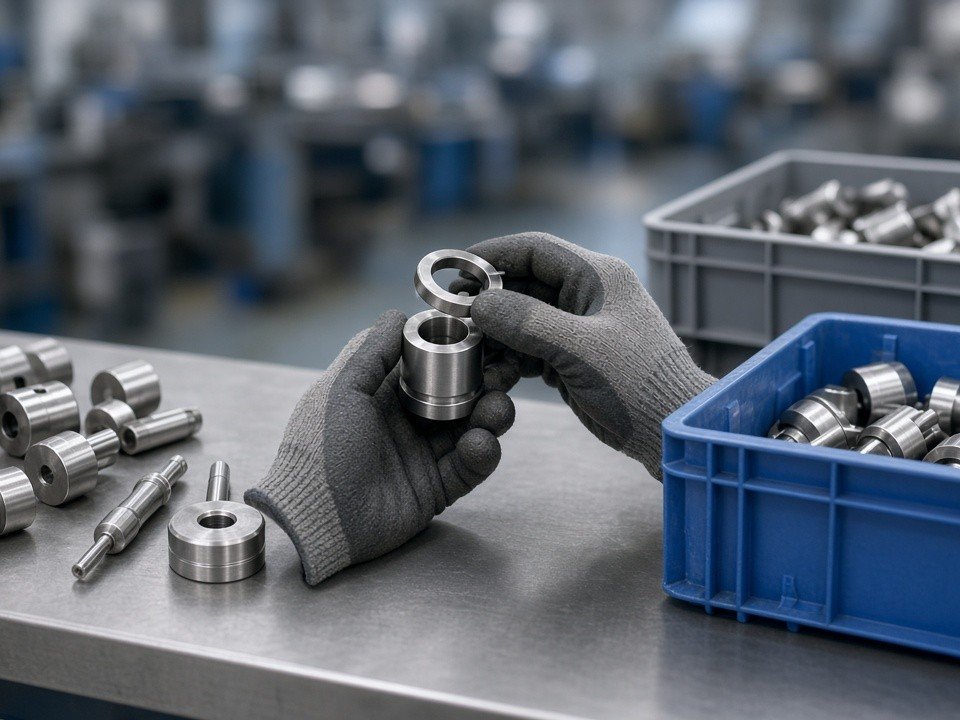
A local engineering team coordinates supplier communication across processes, production stages, and quality follow-up.
Beyond final inspection
Quality management starts before production
Effective supplier quality management means matching each part to a capable supplier, agreeing how requirements will be interpreted and checked, and keeping communication active through production. It also means having a clear way to identify, communicate, and address nonconforming parts.
Practical gaps can have real consequences: a missed drawing revision, a differently interpreted surface finish, or a critical dimension checked only after the order is complete. We help establish requirements and communication paths before production, with checks and records agreed for the part, process, risk, and project.
Clear requirements
Align revisions, specifications, critical features, and acceptance evidence.
Active coordination
Follow agreed checks and keep supplier questions and risks moving.
Visible follow-up
Bring relevant evidence, ownership, and next steps together when issues arise.
One local interface
Coordinate multiple suppliers without chasing every contact
A multi-process BOM may span CNC machining, sheet metal, finishing, and assembly. Managing each supplier independently can leave your team coordinating separate technical contacts, inspection updates, and corrective actions.
BG CNC acts as your engineering, manufacturing, quality, and supply chain interface in China. Our 10 manufacturing engineers, each with more than 10 years of industry experience, coordinate with selected suppliers and keep project communication moving across local working hours and language differences.
What that means for your team
We clarify requirements, follow up on agreed quality activities, and bring issues to your attention with relevant information. Local engineering coordination can reduce time-zone delays and cross-language misunderstandings. It does not replace your own approval requirements; we work to align the project with them.
From supplier selection to delivery
How we manage supplier quality
The checks, evidence, and records are agreed for your project—not assumed to be the same for every part or supplier.
Discuss your quality requirements01 Match the supplier to the part Select manufacturing resources to fit the material, geometry, tolerances, volume, process, quality requirements, lead time, and target cost.
Our core network includes 50+ proven manufacturing partners developed through real project cooperation. We evaluate capability, quality consistency, delivery performance, engineering support, responsiveness, capacity, and problem solving. A supplier suited to a milled aluminum housing may not be the right fit for a formed steel enclosure or molded plastic part.
For projects that require a particular quality system or certification, partner suitability can be assessed. Certification availability and scope depend on the selected partner and must be confirmed for the specific project.
02 Confirm drawings and acceptance requirements Review the information needed to quote, manufacture, and assess the parts.
Reviews can cover drawing revision, material and grade, dimensions and tolerances, GD&T, surface finish, heat treatment, quantity, and critical-to-function features. We raise questions where requirements are unclear or may affect manufacturability, cost, or inspection.
We also confirm which characteristics need focused checks and what acceptance evidence is required, reducing the risk of customer and supplier working to different assumptions.
03 Align the process and quality checks Review process suitability and agree checks appropriate to the part and order risk.
Depending on project risk, the agreed quality plan may include first-article, in-process production, or final inspection. Critical tolerances, cosmetic surfaces, and material requirements can need different evidence from non-critical features. We coordinate the agreed requirements with the supplier before production rather than relying on a generic inspection approach.
04 Coordinate inspection evidence Define records around your requirements and the selected partner’s capabilities.
Requested evidence may include dimensional inspection results, material documentation, finish records, photographs, or sample approval. We confirm what can be provided and when before the order is placed. Share any required formats, traceability, or additional documentation with the RFQ so they can be evaluated during supplier matching and quotation.
05 Follow production and delivery risks Follow agreed checkpoints and coordinate questions, risks, and supplier handoffs.
When a supplier identifies a potential deviation, we work to obtain the facts and communicate the impact so your team can make an informed decision. For multi-process orders, we also coordinate handoffs—for example, from machining to finishing or between components required for assembly.
06 Manage nonconforming parts and corrective action Establish what happened, what may be affected, and what needs to happen next.
Based on project records and the agreed process, a response may include identifying affected quantities, gathering inspection evidence, containing parts, and coordinating a proposed disposition. We share the issue with the relevant supplier and follow up on corrective action.
Rework, replacement, concession, or another disposition follows customer approval requirements and the project agreement. Traceability and corrective-action records depend on the order records and partner process; tell us before quotation if lot-level or other specific traceability is necessary so feasibility can be confirmed.
Manufacturing coverage
Coordinate quality across processes
Process availability, inspection capability, and production capacity vary by partner and project. We review these factors when matching a supplier to the work.
CNC machining
Milling and turning, including 3-axis, 4-axis, and 5-axis machining.
Sheet metal fabrication
Laser cutting, bending, and welding.
Plastic manufacturing
Plastic machining, injection molding, and tooling.
Prototypes
3D printing for development and early evaluation.
Metal forming and casting
Die casting, forging, stamping, extrusion, and investment casting.
Secondary processes
EDM, grinding, surface finishing, heat treatment, assembly, and packaging.
Engineering review
Prevent avoidable cost and quality risks at the design stage
Some quality risks begin with a drawing that is difficult or costly to produce consistently. Our engineers can review whether tolerances are necessary, a feature can be simplified, or the material and finish are appropriate for the part’s function.
We consider production volume as well as geometry. CNC machining may suit prototypes or low-volume runs, while injection molding, die casting, stamping, or forging may be worth evaluating at higher quantities. For some applications, a forged component with secondary CNC machining can be a better route than machining the entire shape from stock.
The goal is to select a practical manufacturing path and make its inspection requirements clear—not to quote a process that creates avoidable cost or quality risk.
Projects that benefit most
Our model is a strong fit for overseas B2B companies buying high-mix, low- to medium-volume custom mechanical parts, including:
- Robotics and automation companies
- Machinery and equipment manufacturers
- Electronics and instrumentation businesses
- Product development teams and overseas machine shops seeking additional capacity
It is especially useful for BOMs with multiple SKUs or processes, repeat orders, special quality documentation, or suppliers that need active coordination. We can support prototype development through low-volume production and help reassess the process as quantities change. For the lowest unit price on a single, very high-volume part, a direct relationship with a specialized factory may be more suitable.
Start with your RFQ
Share your drawings and quality requirements
Our team will review process fit, supplier requirements, and the controls your order may need, then follow up with questions where necessary.
You can also contact us at info@bgcnc.com. Office: Hongrongyuan · Honghu-Technologiepark, Bezirk Longhua, Shenzhen, China.
Send your RFQHelpful information to include
- 2D drawings and 3D CAD files, with revision levels
- Material, finish, heat treatment, and tolerance requirements
- Estimated quantities and repeat-order expectations
- Critical dimensions or functional characteristics
- Required inspection reports, certifications, or traceability
- Target delivery date and assembly or packaging needs
Send your RFQ to BGCNC to begin the engineering and supplier review.