
D2 tool steel · Custom tooling and wear parts
D2 Tool Steel Machining for Custom Tooling and Wear Parts
Coordinate CNC machining, heat treatment, grinding, EDM and inspection through one manufacturing plan. BG CNC helps mold makers, stamping operations, industrial tool builders and equipment manufacturers plan around D2’s wear resistance—and its challenges after hardening.
Share your drawing, material condition and quantity. We’ll review the part and propose a route based on its geometry, critical dimensions and surface requirements.
Send drawings and requirements with your inquiry. Email: info@bgcnc.com
50+
Proven manufacturing partners in our core network, developed through real project cooperation.
10
Manufacturing engineers supporting technical review and supplier coordination.
10+ years
Industry experience among our manufacturing engineers.
Material and application
Why D2 is used for tooling
D2 is a high-carbon, high-chromium cold-work tool steel chosen when abrasion resistance and wear life are important. Its manufacturing route needs to account for how the material changes after hardening.
Common applications
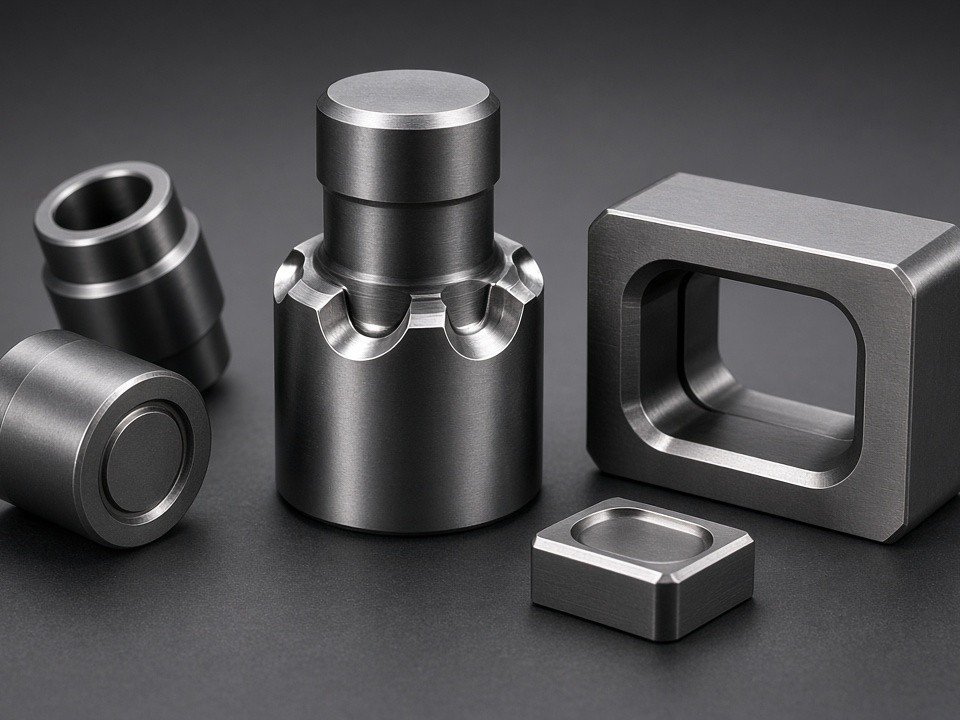
Punches, dies, forming tools, mold components, shear blades, wear plates and replaceable wear elements.
The manufacturing trade-off
D2 can be difficult to machine after heat treatment. Rough machining, finishing allowances and post-hardening grinding or EDM should be planned around part geometry and requirements.
Check the application, not just the hardness
D2 is not automatically the right choice for every tool. Impact loading, toughness requirements, operating conditions, expected wear and maintenance needs should be considered alongside hardness and cost.
Parts we coordinate
D2 parts for tooling and production
We support a single D2 component or a managed set of tooling parts. Mixed materials and processes can be coordinated through one BG CNC contact.
Mold and die
Inserts, cores, cavities, plates and replaceable wear elements.
Punching and stamping
Punches, die sections, cutting edges and stripper components.
Wear tooling
Guide parts, wear blocks, blades and abrasion-resistant components.
Industrial tools
Custom profiles, fixtures and machine components exposed to repeated contact.
Related components
Housings, brackets, plates and other CNC-machined or sheet metal parts.
Process planning
A manufacturing route built around final requirements
We review the drawing to identify which features are best produced before heat treatment and which may need grinding or EDM afterward. The sequence is confirmed for your part—not applied as a one-size-fits-all recipe.
Confirm the part and its acceptance criteria
We review material designation, stock condition, quantity, critical dimensions, hardness requirements and inspection needs. This establishes the manufacturing basis and identifies open questions before the route is set.
Establish the main geometry while machining is practical
CNC milling, turning or drilling can produce the main geometry before hardening. Where needed, finishing stock can be left on surfaces planned for grinding or other final operations.
Coordinate heat treatment against the specification
We arrange heat treatment to the hardness and process requirements specified for the application. Because heat treatment can affect dimensions and distortion, critical features and finishing allowances should be considered in advance.
Finish, inspect and document as agreed
Depending on geometry and condition, final features may be produced by precision grinding, EDM or other suitable operations. We check agreed dimensions and coordinate hardness or other inspection documentation when required and available through the selected manufacturing partner.
RFQ preparation
Project parameters that shape the process
The details below help us select a process and prepare an accurate RFQ response. Final capability and acceptance criteria are confirmed against the drawing and project requirements.
| Parameter | Information to provide | Why it matters |
|---|---|---|
| Material | D2 designation, applicable standard and approved equivalent, if any | Confirms the required material and sourcing basis. |
| Starting condition | Annealed, pre-hardened or other specified condition | Affects machining strategy and operation sequence. |
| Part geometry | 2D drawing, 3D model and critical features | Helps assess CNC access, EDM needs and finishing methods. |
| Heat treatment | Required hardness, standard or specification, if defined | Determines coordination and inspection needs. |
| Critical dimensions | Tolerances, datums, flatness, parallelism and profile requirements | Guides machining allowances and final inspection planning. |
| Surface requirements | Finish, coating or other treatment, if applicable | Identifies secondary processes and acceptance criteria. |
| Quantity and records | Prototype, batch size, repeat demand and requested inspection documents | Helps compare setup and unit-cost implications and define deliverables. |
We do not assume a tolerance, hardness value or certification requirement that is absent from your specification. If a requirement is still being decided, note it in the RFQ so we can flag its manufacturing implications.
Process capabilities
Coordinate CNC machining, grinding and EDM
D2 tooling parts often need more than one process. We coordinate operations around the part’s function, specified requirements and inspection plan.
CNC milling and turning
For profiles, pockets, holes, slots and turned features. Engineering review considers what should be machined before hardening and which dimensions may need finishing afterward.
Precision grinding
May suit precision faces, thickness control, flatness or other specified surfaces after heat treatment. Access, geometry and drawing requirements inform the route.
Wire or sinker EDM
May suit complex profiles, narrow slots or features that are difficult to machine conventionally in the hardened condition. The drawing and functional requirements determine suitability and any extra finishing.
Secondary operations
We can also arrange heat treatment, surface finishing, assembly and packaging when the project calls for them. Availability depends on the selected manufacturing partner and process scope.
One coordinated project team
One contact for multi-process sourcing
BG CNC is based in Dongguan, China. We work with a core network of 50+ proven manufacturing partners and access a broader supplier base, matching projects according to material, geometry, tolerance, volume, quality requirements, lead time and target cost.
For a D2 project, we can coordinate CNC machining, heat treatment, grinding, EDM and inspection as a connected manufacturing plan. You communicate with one BG CNC team while we manage supplier coordination and technical follow-up in China.
Engineering review can help assess
- 01Which features should be machined before heat treatment?
- 02Where should finishing stock be allowed?
- 03Is grinding or EDM more appropriate for a critical feature?
- 04Are specified tolerances necessary for the part’s function, or could another process or material condition reduce total cost without compromising requirements?
We focus on the total manufacturing route, not just the price of the first operation.
Quality planning
Agree acceptance criteria before production
We review drawings, inspection points and requested records, then match the job with a manufacturing partner whose capabilities and quality systems fit the project.
For material traceability, dimensional inspection, hardness documentation or other records, include the requirements in your inquiry. We’ll confirm what can be provided before production is released.
Quality system options depend on the selected partner
Our partner network includes suppliers operating under internationally recognized quality systems. Depending on the partner and project scope, certification options may include:
- ISO 9001
- IATF 16949
- ISO 13485
- AS9100D
Certification availability and scope must be confirmed for the actual manufacturing partner selected for each RFQ.
Material fit
Is D2 right for your project?
D2 may be a good candidate when abrasion resistance and wear life are priorities, particularly for cold-work tooling and components exposed to repeated material contact. It may be less suitable when the part faces severe impact or another property takes priority over wear resistance.
We can review D2 against your application and manufacturing plan. Depending on quantity and product lifecycle, we can also assess whether another process or material route is worth comparing. Any alternative must meet your technical requirements and be approved by you.
A good service fit
For teams managing parts, suppliers and processes
- Tooling and industrial companies sourcing custom inserts, punches, dies or wear parts.
- Machinery and equipment manufacturers with multiple machined components.
- Product development teams moving from prototype to repeat production.
- Overseas manufacturers needing a local China partner to coordinate several processes.
- Buyers who value drawing communication, delivery visibility and consistent supplier management alongside unit cost.
Request a quotation
Send your D2 tool steel RFQ
Send the information you have available. We’ll review it, identify open technical questions and return a proposed manufacturing route and quotation for your review.
Helpful RFQ details
- 2D drawing and 3D model
- D2 material specification and starting condition
- Heat-treatment or hardness requirements
- Critical dimensions and surface requirements
- Quantity, target delivery date and expected repeat demand
- Inspection, traceability or packaging requirements
BG CNC · Dongguan, China
Hongrongyuan · Honghu-Technologiepark, Bezirk Longhua, Shenzhen, China
Email: info@bgcnc.com