
Precision CNC manufacturing
17-4 PH stainless steel machining, engineered around the heat-treatment cycle
17-4 PH (Grade 630) combines high strength and hardness with excellent corrosion resistance. BG CNC coordinates machining, heat treatment, and precision finishing to help control dimensional change and reduce manufacturing risk.
For aerospace, energy, valve, and other high-stress applications, the right process sequence is as important as the material itself. BGCNC works with your drawings and requirements to plan the route from raw stock to finished component.
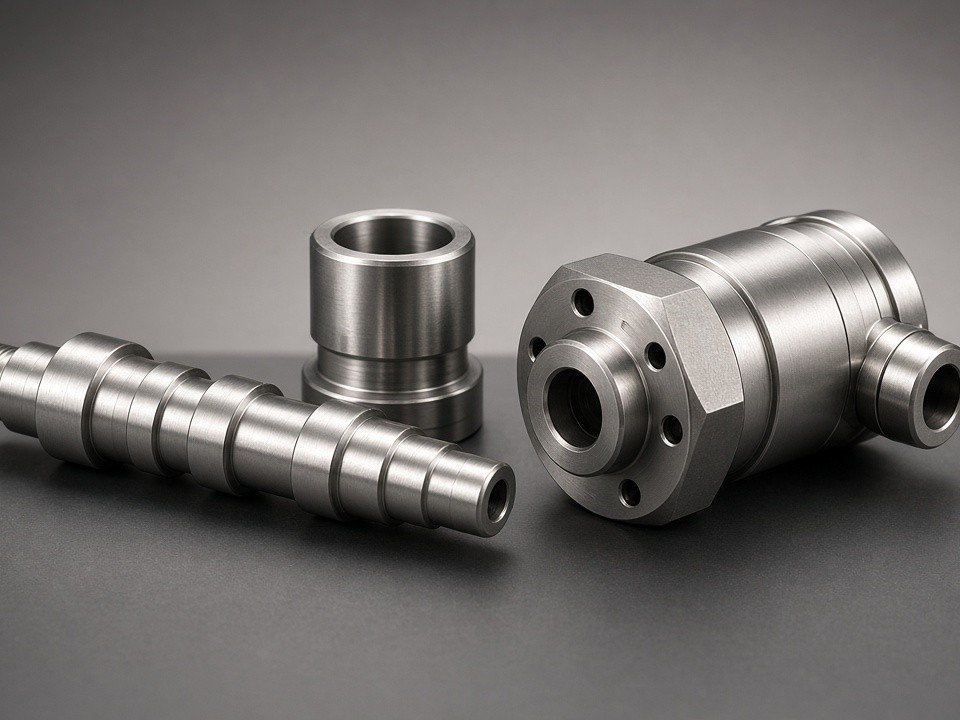
One coordinated manufacturing path
Plan material condition, aging cycle, machining sequence, and final inspection together—not as disconnected supplier steps.
Material
17-4 PH / Grade 630
Typical condition
H900: 40–44 HRC
Manufacturing focus
Heat treat + finish machining
Applications
Aerospace, energy, valves
Material profile
Strength and corrosion resistance in one alloy
17-4 PH is a martensitic precipitation-hardening stainless steel. It can be machined in an annealed state, then aged to achieve specified mechanical properties. This balance makes it a practical choice where high torque resistance or high-pressure containment is needed without moving to an exotic alloy.
Typical applications include valve stems, aerospace structural fasteners, pump shafts, and industrial turbine components. Machinability varies with material condition, so process planning starts with the required final properties.
Typical properties in Condition H900
Values are typical reference figures; confirm project requirements against the applicable material specification.
| Property | Typical value |
|---|---|
| Tensile strength | ~1310 MPa |
| Yield strength | ~1170 MPa |
| Hardness | 40–44 HRC |
| Corrosion resistance | Excellent; comparable to 304 |
| Machinability | Moderate; varies by heat-treatment state |
Engineering-led process
Control the sequence to protect final dimensions
The machining route determines cost, tool life, and the risk of distortion. BG CNC coordinates thermal processing with roughing and finish operations, accounting for dimensional changes that can occur during aging.
Roughing strategy
Preserve tool life before aging
Rough machining while stock is annealed helps maximize tool life and reduce cycle time. The plan accounts for stock allowance and the features that will need precision finishing after thermal processing.
Thermal processing
Target the required mechanical properties
We coordinate aging conditions such as H900, H1025, and H1150 around your hardness and tensile requirements, with material and process traceability considered as part of the manufacturing route.
Precision finishing
Account for change and verify critical features
High-precision CNC milling and turning bring parts to final tolerance after aging. Planning for slight dimensional changes helps prevent oversized or warped parts and supports control of complex GD&T requirements.
A coordinated supply chain
One point of contact from material to inspected part
Managing machine-shop and heat-treat vendors separately can create gaps in certification, traceability, and dimensional responsibility. BGCNC coordinates these steps so you receive a finished component ready for assembly.
Material certification
Verification of chemistry and source material to support applicable aerospace or medical requirements.
Process documentation
Traceability from raw billet through thermal processing and final inspection.
Tolerance and dimensional control
GD&T requirements are considered in the process plan, including the effects of heat-treatment stresses on complex geometries and final dimensions.
Production planning
Match the route to your volume and tolerances
The goal is to machine only what the design needs while maintaining precision at functional interfaces.
5-axis CNC machining
For small quantities, 5-axis machining can help minimize setup costs and lead times while supporting complex part geometry.
Evaluate near-net-shape options
For larger runs, forging or investment casting may be evaluated with targeted CNC machining on critical features to reduce unnecessary machining time.
Quality assurance
Verify more than appearance
Critical components need dimensional and material-condition checks aligned with their application and drawing requirements.
-
Dimensional verification
CMM inspection for complex geometries and specified dimensional requirements.
-
Hardness testing
Rockwell or Brinell testing to verify heat-treatment outcomes.
-
Surface integrity
Monitor tool marks and thermal damage that could contribute to stress corrosion cracking in high-pressure environments.
Start a project review
Get a quote for your 17-4 PH component
Share your CAD files, quantity requirements, material specifications, tolerances, and heat-treatment needs. Our engineering team will review the DFM requirements and provide a clear assessment of the manufacturing path.
Send your RFQ to info@bgcnc.com
Discuss your RFQEngineering inquiry
Contact our team about 17-4 PH and other high-strength stainless steel projects.
BGCNC